

As part of updating the LHF Atlas of Homelessness Services, we have refreshed the information we hold on specialist health services that support people who are rough sleeping or at risk.
One of the most widespread specialist health service models is the Hospital Support and Discharge Teams operating across London hospitals. These specialist multidisciplinary teams work within acute settings to support people experiencing homelessness throughout their hospital stay, helping them access care safely and avoid being discharged without the right follow-on support. The value of the teams is reflected in patient feedback.
“The team have been really great, they’ve come to see me once, twice a week they’ve helped me out really well … They make you feel comfortable. I’ve actually stayed in, done my treatment because of the staff I’ve met.” (Pathway patient)
“I am happy that the homeless team […] are helping me with finding accommodation, as I was evicted and my landlord stated that I cannot come back. The Homeless Team have been helpful, they have given me a phone, given me some new clothes and I have been informed that they will be supporting me to move into accommodation when I am discharged for 6 weeks before [the local authority found] me somewhere more permanent to live. I am grateful as I do not have to sleep on the streets.” (Pathway patient)
Hospital Support and Discharge Teams are based on the Pathway hospital team model which was initiated in 2009 at UCLH, following the death of a patient who had been discharged onto the street. This tragedy prompted clinicians to create a more humane, coordinated approach and to the establishment of Pathway to deliver this, initially in London. You can find out more about the history of Pathway and its broader work in inclusion health here.
The model brings together clinicians, housing workers, link workers and social care practitioners who provide holistic assessments, help people register with a GP, advocate for safe discharge and connect patients with community and housing support. Today, they operate across the country, with some teams delivered by Pathway, and others by different providers for example, in-house teams.
The Pathway Partnership Programme Annual Report highlights the pressures Hospital Support and Discharge Teams face, including rising complexity, increasing numbers of patients with no recourse to public funds, limited step-down accommodation and ongoing funding uncertainties. This context makes the work of Hospital Support and Discharge teams more important than ever. In 2024/5, the network of teams on Pathway’s Partnership Programme alone reduced returns to rough sleeping by 62% and to sofa surfing by 33%. A financial analysis estimated that the teams saved the NHS over £9 million per year in avoided costs and made over 13,000 bed days available for other patients by reducing readmissions and driving joined up working with community services.
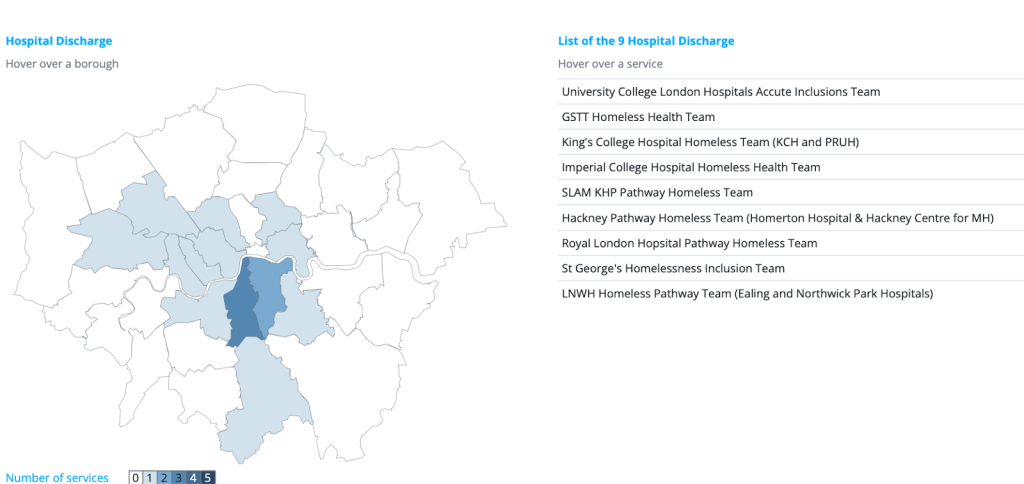
The updated Atlas Health Map reflects nine Pathway-model services across London, covering boroughs including Camden; Croydon, Lambeth, Lewisham and Southwark; Ealing; Hammersmith & Fulham, Kensington & Chelsea and Westminster; Hackney; Tower Hamlets; and Wandsworth. These teams operate across major hospitals such as UCLH, King’s, Guy’s and St Thomas’, Homerton, the Royal London, Imperial sites, Ealing, Northwick Park and St George’s. You can also find information about a range of other specialist health services including primary care, mental health and drug and alcohol services on the Atlas Health Map.
If you have comments, ideas or spot an error any time please get in touch with the Atlas team – becky.rice@lhf.org.uk and gareth.thomas@homelesslink.org.uk