
In this four-part blog series, two to be published in the next few weeks with the final two following in January, LHF Associate Becky Rice explores what happens after the grant ends, revisiting projects LHF supported at critical points in their development to find out what happened next.
Introduction
LHF captures the activities and outcomes supported by its grants through regular monitoring reports from grantees. At a focus group with organisations we support, it was suggested that this leaves an important part of LHF’s impact untold.
As independent funders, LHF often supports new and potentially risky ideas, and projects in areas that are hard to secure support from more ‘mainstream’ funders. It also provides targeted consultancy or ‘SOS’ support. The impact of this kind of work can be felt over many years, the post-grant legacy may be just as important as what’s visible during the grant itself.
For funders, that’s not always easy to see. Monitoring reports tend to capture what happens during the grant period. But what happens five years later? What becomes possible because an organisation had someone willing to back it early on?
This is the first in a series revisiting projects LHF supported at critical points in their development, to find out what happened next.
Years: PACT
The first in a series looking at LHF’s long-term impact
This is the first in a series revisiting projects LHF supported at critical points in their development, to find out what happened next. Further blogs will be posted at the end of November and then in January.
PACT: pioneering family-focused support in prisons
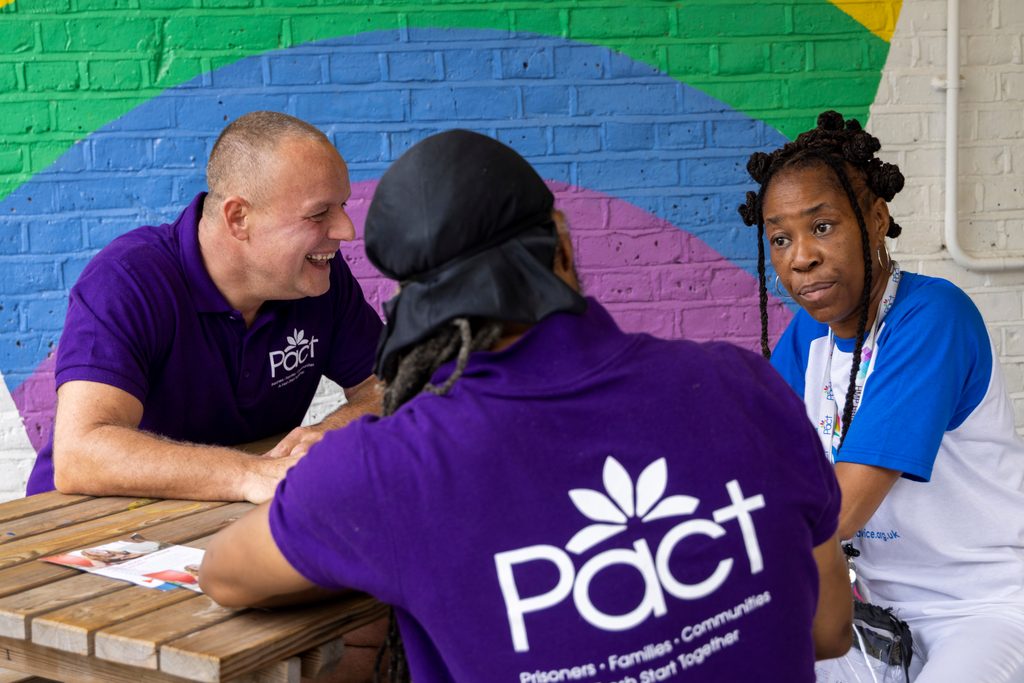
PACT is a national charity supporting prisoners, people with convictions and their families. It has long led the way on family-based prison support, recognising that strong relationships are key to preventing homelessness, reducing reoffending and helping people resettle successfully. LHF supported PACT over more than ten years, through several grants totalling over £200,000 and as an influential project partner, offering advice as well as funding.
How it started
PACT believe that people who keep strong family connections are far more likely to thrive after release. Yet statutory services rarely offered the support needed to sustain those relationships. In 2009, PACT decided to develop a model to test whether focusing on family ties could make a real difference.
LHF was actively looking to support organisations working to break the cycle of offending, imprisonment and homelessness. A board member approached PACT’s Chief Executive Andy Keen-Downs, and identified prison-based family support as an area that would be hard to fund and carried some risk but had the potential to bring about significant change. The two organisations started to work together.
The result was a pilot placing family support workers in two London prisons. The promise of match funding from LHF helped secure a contribution from HMPPS, and as the project progressed, PACT, HMPPS and LHF formed a partnership to help steer it. That partnership secured an extension and made sure early evaluation findings shaped what came next.
Andy explains: “We at PACT made ourselves very useful [to prisons], and what LHF did was to come alongside us and create that three-way partnership between the voluntary sector provider and innovator, the philanthropic partner who’s willing to take a risk, and the officials who are saying ‘we’re not getting it through this year due to funding but let’s gather more evidence and work together to see if this is something we can build to scale’.”
Building the evidence
The pilot and its extension did two important things. It won support for the model among prison staff, which encouraged HMPPS to invest further. And it created space to build an evidence base, through small-scale evaluations by Roehampton, the New Economics Foundation and Cambridge University.
With continued support from LHF and several other grant funders, the pilots spread to new settings, including the women’s prison estate through the Journeys to Freedom project: an intensive, flexible programme for women nearing the end of, or leaving, longer sentences and facing complex family, housing and employment challenges. It combined small caseloads, practical resettlement support and work experience, helping women rebuild family relationships before release.
LHF worked alongside PACT on practical demonstration, evidence-gathering and learning over time, a “show and tell” approach to test whether the model could work at scale. Together, the pilots helped build the evidence and confidence for HMPPS to adopt family support as a mainstream, national service.
Where PACT is now
Family-focused prison support is now commissioned nationally by HMPPS through the Prisoner, Family and Significant Other Services framework, and PACT is the official family services provider in 62 prisons across England and Wales.
For PACT, the ambition was always about embedding a model rather than growing the organisation. It has openly shared its intellectual property with partner organisations so the model can be replicated widely.
“The ambition was always for this to become a mainstream role – like a health visitor or a teaching assistant – rather than something exceptional.”
Not every strand of the work has lasted. Sadly, HMPPS has ceased funding for the women’s resettlement workers. One factor was that engagement with probation was a core feature of the work and pressures on the probation service made this very difficult to achieve.
New Commissioned Rehabilitative Services contracts are now being tendered, with the new services due to start in 2027. Family support is core to the model for the community link workers who will work in custody and in the community, alongside housing, finance, benefits and debt advice.
LHF was more than a funder for PACT. It worked as a partner and adviser, helping PACT test different approaches, build the evidence and navigate a complex statutory environment. Not everything lasted, but the shift PACT describes is an important one: family support is increasingly seen as part of its core work, rather than something additional or peripheral.